
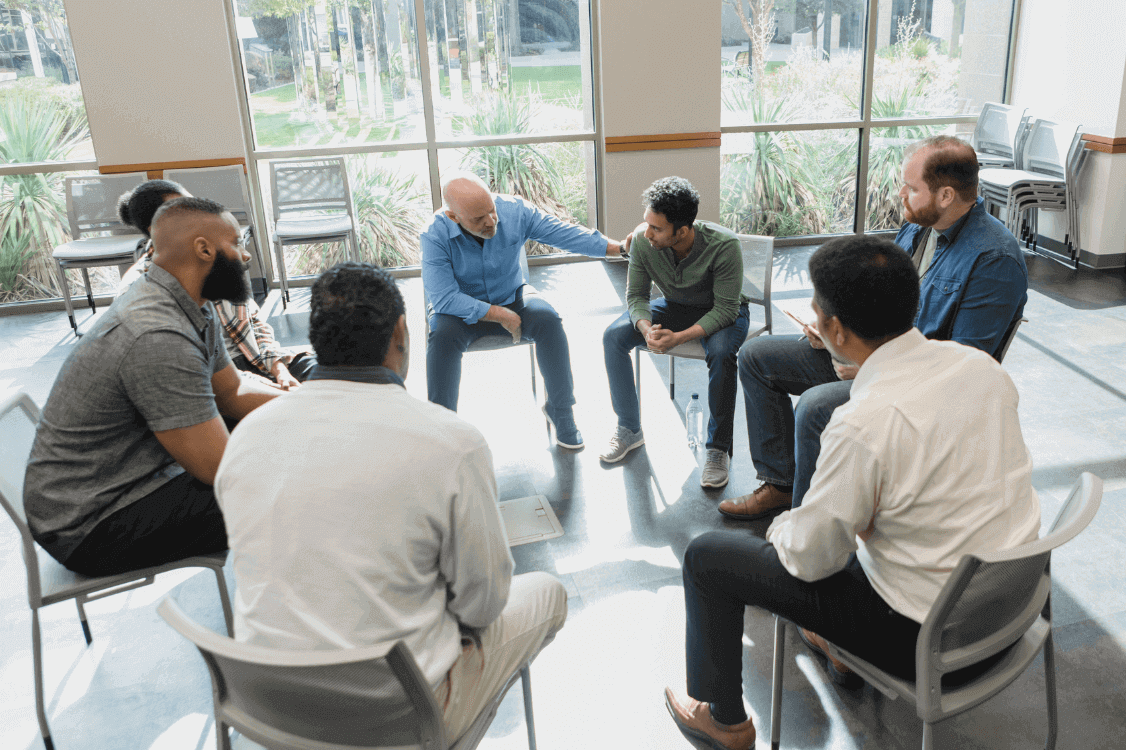
Assessing addiction treatment options raises some critical questions about which approach will work best for your situation. The distinction between 12-step vs. non-12-step rehab is one of the most fundamental choices you’ll encounter when exploring recovery programs.
Neither pathway is universally superior. The right approach depends on your personal values, mental health needs, and what resonates with your understanding of recovery. Many people find success combining elements of both methodologies.
The guide examines what each approach offers, how they differ, and how to determine which direction best serves your recovery journey.
What Is 12-Step Treatment?
The 12-step model originated with AA (Alcoholics Anonymous) in 1935. Founder Bill Wilson and Dr. Bob Smith developed a framework for recovery based on spiritual principles, mutual support, and personal accountability. Their approach spread rapidly and now serves as the foundation for numerous fellowships addressing various addictions.
The philosophy centers on acknowledging powerlessness over substance use, surrendering to a higher power in some form, taking moral inventory, making amends, and helping others in recovery. This model treats addiction as a spiritual condition that requires spiritual solutions alongside practical behavioral modifications.
Core elements include the 12 steps themselves – a sequential progression of principles guiding personal transformation. Participants work through these steps with guidance from a sponsor, someone further along in recovery who provides mentorship and accountability. Regular meetings bring people together to share experiences, offer support, and reinforce commitment to sobriety.
The fellowship aspect distinguishes 12-step programs from purely clinical treatment. Members become part of a community that extends beyond formal treatment settings, providing lifelong support networks accessible wherever meetings are held.
Sponsorship creates one-on-one relationships that deepen accountability. Sponsors share their own recovery journey, guide newcomers through the steps, and offer support during challenging moments.
What Is Non-12-Step Treatment?
Non-12-step rehab encompasses a broad range of evidence-based therapies, clinical interventions, and holistic modalities that don’t rely on the traditional 12-step framework.
Evidence-based therapies form the clinical backbone of non-12-step treatment approaches. CBT (cognitive behavioral therapy) helps identify and change thought patterns driving addictive behaviors. DBT (dialectical behavior therapy) builds emotional regulation and distress tolerance skills. EMDR (eye movement desensitization and reprocessing) addresses trauma that often underlies substance use disorders. MAT (medication-assisted treatment) uses FDA-approved medications to reduce cravings and support recovery from opioid and alcohol addictions.
These approaches rest on scientific research demonstrating their effectiveness. Treatment plans are individualized based on clinical assessment rather than following a standardized progression of steps.
Holistic and experiential modalities address recovery from multiple angles. Yoga, meditation, and mindfulness practice promote body awareness and stress management skills. Art therapy and music therapy provide creative outlets for processing emotions. Adventure therapy and surf therapy build confidence through challenging physical experiences. Nutritional counseling supports physical healing and restoration.
Non-12-step programs often integrate different modalities based on individual needs. A client with a significant trauma history might receive intensive EMDR alongside group therapy and yoga. Someone with co-occurring depression might combine CBT with medication management and exercise programming.
Key Differences Between 12-Step and Non-12-Step Approaches
Understanding the difference between 12-step vs. non-12-step rehab helps you evaluate which approach aligns with your needs and preferences.
Spiritual versus secular emphasis is the most prominent difference. 12-step programs explicitly incorporate spiritual concepts, including surrendering to a higher power and seeking spiritual awakening. While participants can define “higher power” broadly (as God, nature, the group itself, or any external force), the spiritual language and framework are central to the methodology.
Non-12-step approaches typically operate from a secular foundation. They address addiction through psychological, behavioral, and medical lenses without requiring spiritual belief or practice. This appeals to individuals who are uncomfortable with religious or spiritual frameworks and seek 12-step alternatives grounded in clinical science.
Groups versus individualized structure reflects different theories about how recovery works. 12-step programs emphasize collective experience and shared identity as people in recovery. Everyone works the same steps in the same sequence. Meetings follow consistent formats. Uniformity creates belonging and reduces isolation.
Non-12-step treatment prioritizes individualization. Clinicians assess each person’s unique history, co-occurring conditions, trauma background, and personal goals, then design treatment accordingly. Two people in the same program may receive quite different therapeutic interventions based on their unique needs.
Neither structure is inherently superior. Some people thrive with the consistency and community of a 12-step fellowship. Others need the personalized attention of clinical treatment targeting their particular challenges.
Can You Combine 12-Step and Non-12-Step?
Many successful recovery journeys incorporate both approaches. Rather than viewing them as competing philosophies, consider them complementary tools serving different aspects of healing.
Research supports integration. Studies demonstrate that people who engage with mutual support groups like AA or NA alongside professional treatment often achieve better outcomes than those using either approach alone. The combination provides clinical expertise plus ongoing community support that extends beyond formal treatment.
Most treatment centers, including those not explicitly 12-step based, encourage clients to attend AA, NA, or similar meetings as part of their recovery plan. The fellowship offers something professional treatment cannot: a community of peers available around the clock in every city, for life.
The effectiveness of this combination stems from what each approach uniquely provides. Clinical treatment delivers professional assessment, evidence-based therapy, trauma processing, medication management, and individualized care planning. 12-step fellowship provides peer community, ongoing accountability, spiritual growth for those who seek it, and a framework for living that extends beyond formal treatment.
Using both means you’re not relying on a single system to meet all your recovery needs. You gain clinical tools to understand and change your behavior while building a support network that continues long after treatment concludes.
Choosing the Right Approach for You
Selecting a treatment approach requires honest self-reflection about your values, needs, and past experiences with recovery attempts.
Personal values and comfort level matter greatly. If spirituality already plays a defining role in your life, 12-step programs may feel like a more natural fit. If religious or spiritual language causes discomfort, you might engage more fully with secular clinical approaches and 12-step alternatives. Consider what genuinely strikes a chord rather than what you think you “should” prefer.
That said, maintaining an open mind serves recovery well. Many initially skeptical individuals find unexpected value in the 12-step fellowship after experiencing it firsthand. Others who assumed they wanted a spiritual approach discover that evidence-based therapy addresses their needs more directly.
Mental health needs and trauma history influence which approaches will prove most effective. Complex trauma, severe anxiety or depression, and other co-occurring mental health conditions often require specialized clinical intervention, trauma-focused CBT, and psychiatric medication management to address these issues in ways that 12-step programs alone cannot provide.
If you’ve experienced pronounced trauma, treatment incorporating evidence-based trauma therapies should be a priority. You can still engage with a 12-step fellowship, but clinical care provides essential tools for healing wounds that underlie addictive patterns.
Consider what hasn’t worked previously. If earlier attempts at recovery through one approach failed, exploring alternatives makes sense. Different methods work for different people at different stages of their journey.
How Anchored Recovery Community Integrates Both
At Anchored Recovery Community, we recognize that effective treatment draws from multiple traditions and modalities. Our approach combines clinical excellence with community support.
12-step principles appear where appropriate in our programming. We encourage clients to attend AA, NA, or other fellowship meetings to build sustainable recovery. The community connections and accountability these groups provide complement our clinical work. For those who find meaning in the steps, we actively support that journey.
Our sharp focus on clinical and holistic care ensures that treatment addresses your specific needs comprehensively. Our PHP, IOP, and OP programs deliver evidence-based therapies, including individual counseling, group therapy, and specialized modalities like EMDR. We address trauma, co-occurring mental health conditions, and the underlying factors driving addiction.
Holistic offerings like yoga and surf therapy support whole-person healing. Our trauma-informed approach recognizes that lasting recovery requires more than behavioral change. It requires processing the experiences and emotions that fuel substance use.
Many of our staff are in recovery themselves, bringing both professional expertise and personal understanding to their work. We meet clients where they are on their journey.
Whether you connect more with the 12-step philosophy, prefer purely clinical approaches, or want to explore both, Anchored Recovery Community provides the flexibility and support you need. Call (949) 696-5705 to discuss which approach might work best for your situation.
FAQs
Do I have to believe in a higher power to recover?
No, belief in a higher power is not required for successful recovery. Many people achieve lasting sobriety through secular, evidence-based treatment approaches that don’t incorporate spiritual elements.
What if I tried AA/NA before and it didn’t work?
Previous challenges with the 12-step program don’t mean recovery is impossible, they simply indicate that the approach may not be the right fit for you. Evidence-based clinical treatment, alternative support groups, or combining different modalities may prove more effective for your situation.